Tuesday, September 7, 2021

Why combine story and yoga?


Story and yoga build literacy skills that’s why - language, physical literacy and emotional literacy!


Story and yoga both come from a place of stillness. Story settles the body down so the mind can listen, and yoga settles the mind down so we can become aware of our bodies. We find repose from the frenetic pace of life. When children learn to focus their energies, they gain control of their lives.


Here are 12 benefits of combining story and yoga.


#1

Story and yoga promote literacy, health and well-being. The power of story andthe wisdom of yoga enhance kids’ natural curiosity about the world while encouraging their innate creativity, and engaging them in mindful movement.

#2

Story and yoga engage kids. Kids love stories and yoga brings the story to life. Story and yoga improve literacy skills by encouraging kids to retell the story with yoga poses. Using their own words, they are able to recall the beginning, middle and end. Comprehension complete!

#3

Story and yoga capture the imagination. Yoga stories are a super way to encourage kids to use their imaginations. Imagination enhances critical thinking skills. When practicing the poses, they imagine the characters and setting. Kids learn that their imaginations are limitless and can take them on adventures, anywhere and anytime!

#4

Story and yoga improve visualization. Along with exercising the body and the imagination, story and yoga allow kids to visualize. They learn that stories come alive within their minds. Even without a book, kids can listen to a story and see it in their minds eye through visualization!

#5

Story and yoga teach sequential thinking and planning. Listening to story and following instructions on how to do a yoga pose reinforces an order of events. Sequential thinking is important in planning. Structure and syntax matter to the meaning and understanding of sentences, and you cannot balance in Tree Pose if you do not set it up correctly!

#6

Story and yoga build connections. Children must be able to build a connection to the characters and setting in a story. Yoga creates a connection between the mind and the body. Kids build compassion and empathy for themselves and others by connecting emotionally to the story!

#7

Story and yoga teach self-regulation. Yoga teaches us to control our bodymovements and to be mindful of our breath. Whether children are reading a story out loud or silently to their self, they need to regulate their voice, pace and cadence. They also use their breath to pause at periods and commas!

#8

Story and yoga teach mindfulness. Story and yoga both come from a place of stillness. Story settles the body down so the mind can listen, and yoga settles the mind down allowing us to become aware of our bodies. Kids become focused, purposeful in their yoga practice, and gain control of their own life!

#9

Story and yoga improve speaking and encourage self-expression. Vocal ability improves as the voice is used in tandem with postures. Kids build confidence when encouraged to express themselves through acting out the story with yoga postures!

#10

Story and yoga support multiple learning styles. Visual learners see the story through the yoga postures. Auditory learners hear the narrative and instructions to the poses, and kinesthetic learners notice and feel the body while practicing the yoga.

#11

Story and yoga encourage cooperation. Kids focus on the adventure, not the perfect posture. They learn the value of teamwork when they practice yoga with others. Whether listening or reading to a sibling gives them an opportunity to share and care for each other.

#12

Story and yoga encourage joy and a positive outlook. Kids love listening to stories. They enjoy retelling the story with yoga becoming a dog, an elephant and other aspects of the story. Combining stories and yoga is just plain fun!


Through the magic of story and the wisdom of yoga let the adventure begin!


Namaste, Kathe


Tuesday, August 3, 2021

What's the buzz?


The world of yoga is immense, there is always something new to learn. I recently discovered that humming boosts immunity! Most of us know that gentle yoga practices build a strong immune system. You may be thinking, ok, but what does humming have to do with yoga? Well, here's the story. 

Brahmari, humming bee breath is a yoga breathing practice. Brahmari can help to balance the autonomic nervous system, and stimulate the parasympathetic nervous system, which calms us down. Benefits in and of themselves, yet scientific research has found an added benefit to humming. It produces nitric oxide!

Nitric oxide (NO) is a molecule that’s produced naturally by your body, and it’s important for many aspects of your health. NO relaxes blood vessels, causing them to widen and increase circulation allowing blood, nutrients and oxygen to travel through the body effectively. NO is known to be antifungal, antiviral, and antibacterial. Nitric Oxide is produced in the paranasal sinuses, a group of four air-filled spaces that surround the nasal cavity. Humming increases NO levels opening up airways and killing pathogens. I didn’t know any of this!

Let’s talk a bit about the practice of breathing in yoga, and its effects on our overall well-being. Yoga philosophy sees our breath as the physical manifestation of prana. Prana can be considered the lifeforce of the universe. Breath brings life to our being, without breath there is no life. Breath practices in yoga are called pranayama. One of the big benefits of pranayama is its ability to calm us down.

According to research studies mental health difficulties are a global issue. Psychological distress such as depression and anxiety are on the rise. One way we can take care of ourselves is through the practice of pranayama. The flow of breath regulates the movement of life force-prana in our bodies. Our breath keeps us alive and vibrant.

Pranayama is different than our natural breathing. It is the conscious, deliberate regulation of the breath. Pranayama can have a strong effect on the body and mind. Therefore, breathing exercises should be practiced with awareness. It is best to practice a couple of hours after eating or on an empty stomach. Always spend a few minutes afterwards in rest pose, this allows the nervous system to absorb the benefits of the practice.

Brahmari, humming bee breath, is appropriate for beginners. It is a simple exercise, practiced regularly it helps to boost immunity. Brahmari can have a significant impact on our physiological system. It reduces stress, induces calmness, enhances sleep, lowers heart rate and blood pressure, increases lymphatic circulation and creates new neural pathways in the brain. All of these promote health and well-being!

How to Practice

Sit tall in easy pose, sitting mountain, or in a chair with your feet flat on the ground. Feel your seat upon the earth, let it be steady, stable and secure and your head lifted high towards the sky. Close your eyes. Soften the jaw. Choose a hand position.

1. One hand on the belly and one hand on the heart.

2. Cover your ears with your hands.

3. Close the ears with the thumbs and place the fingers on top of your head.

Relax your shoulders. With mouth closed, inhale through your nose, then exhale slowly and gently though your nose making a “hummmmm” sound. Pause, then inhale and repeat. Beginners should practice for 3 minutes working up to 5 - 10 minutes. Brahmari can be practiced several times a day if you feel you are coming down with a respiratory infection, sinusitis or are just feeling unwell.  

When doing this exercise, the vibrations you might feel are helping increase air circulation and the production of nitric oxide in your nasal and sinus cavities. The vibrations certainly feel like a buzz! Most of us associate humming with happiness and you may notice that it’s difficult to hum and feel bummed at the same time.

Happiness and health!

Kathe

Saturday, June 12, 2021

Shall we dance?


                                  Nataraja Lord of the Cosmic Dance


Most of us take things too seriously. We invest in our issues, our dramas. Wondering, should I, shouldn't I? We have a vision of the way things should be, could be, ought to be. Obviously, this is a big source of stress. However, if you take an issue and look at it from another perspective, injecting a bit of humor, you laugh. It's very liberating when we learn to take ourselves lightly. 

Vision motivates us, providing momentum to act and that's important. What would life be without dreams and desires? They give us direction and light our way, but stuff happens. We're not in control of illness, loss, or misunderstanding. All we can do is respond in the best way possible. When you see your own drama, you see how you get trapped in a story. You see how the mind appears to make it real. Yet we are so much more than our stories. Can you imagine getting to a place and just allowing things to happen without adding to the drama by creating a story around it? Wouldn't it be great to realize that it's all just the process of life? 

Consciousness has an ability that allows us to deal with our issues responsibly with a certain lightness. The Sanskrit word for dance is called Lila. Lila is the dance or play of life. Dance - play does not mean insignificant; it means it has the quality of lightness. Imagine consciously moving through the dance of life. It's delightful when you spend time with someone and both of you can see what lies beyond appearances. Life then becomes free, a chance to play and dance! Though we can't force anyone to come out and play, we can always ask...shall we dance?

Enjoy the dance, Kathe


Monday, February 22, 2021

Recognizing the Divine Within


Namaste!  We say Namaste at the end of yoga class, but Namaste is actually a greeting.  It means "the Divine Light that shines within me sees the Divine Light that shines within you".  We have forgotten that we are Diving Beings.  We are not simply human beings living an ordinary life on earth until we die.  Yes, we are all human beings, but we are more than that, we are both human and Divine.  We are Divine Beings living in a human body for a short while.  

We are all unique and we are all the same.  This statement may sound like a contradiction, but what it expounds is that we are each a unique expression of the One Divine.  Yoga teaches us that we are all One; One Divine Being manifesting as different Beings.  Since we mostly don't realize this, we tend to blame one another for our perceived differences.  We each grow up in a certain place, with particular parents under differing circumstances and are thus unique individuals.  No one has had our distinctive set of experiences; therefore, no one perceives in exactly the same way that we do, not even two people who grow up in the same household.  When we feel hurt by something someone said or did remember that they were only acting out what they knew, from what they have been conditioned to believe according to the unique set of circumstances that made them who they are.  We are individual beings free to decide whom we wish to keep in our life and whom we wish to let go of, and at the same time it's important to understand that those who have harmed us, couldn't have done differently at that time, given the pain that they were carrying, and the lack of understanding that they had in that moment.  When we realize the truth of this, our perspective changes; we have a change of heart if you will and realize the power of forgiveness.  Forgiveness is not approval; forgiveness grants us a heart that is free from animosity.  Forgiveness is beyond what is okay and not okay, it is an accepting of reality and a willingness to move on.  This makes me think of the beautiful adage by the 13th century Persian poet, Rumi, "Out beyond ideas of wrongdoing and right doing, there is a field, I'll meet you there."  This isn't a simple concept we learn and then are done; this is a process, something we must continuously work on from moment to moment.  This past year, (2020) the whole country has been predominantly divided.  I have personally struggled with these feelings of division.  How does one advocate one's beliefs while at the same time remember that we are all One?  I believe it takes a lot of contemplation and prayer.  

If you would like to extend love and compassion to others try this simple exercise.  Sit with a long spine; on a chair with both feet flat, or you may prefer to sit on the floor with your legs crossed.  Bring your palms together in prayer pose, Anjali Mudra.  With reverence, bring your palms to your forehead and say out loud or silently, "may I have kind and compassionate thoughts".  Bring your palms down to your lips and say, "may I speak kind and compassionate words".   Bring your palms down to your heart center and say, "may I always consider kind and compassionate actions".  Bow your head toward your heart as you contemplate the practice.

"We need more light about each other.  Light creates understanding, understanding creates love, love creates patience, and patience creates unity." - Malcolm X

Yours with Light and Love,
Mel


Saturday, November 21, 2020

When the rubber meets the road


In yoga we learn about awareness; awareness of our body, awareness of our breath, awareness of our emotions, awareness of our thoughts. Yoga is a life-long practice of cultivating awareness in all its forms and it truly begin when we step off the mat, that's when the rubber meets the road. 

When the rubber meets the road is the point at which a theory or idea is put to a practical test. It's the moment of truth, it's the reason we practice! It lets us know if we've learned anything or if we've just been going through the motions. 

The very essence of yoga is to reconnect to the Divine, within ourselves and others. Yoga teaches us that we are all One; everything, everyone, every experience and every relationship is a pathway to the Divine. 

So, how do we cultivate awareness? How do we reconnect with the Divine? How do we connect with others while staying connected to ourselves? Well one way is the practice of Loving-Kindness meditation. Loving-Kindness meditation is likened to the butterfly effect or life ripples in a pond. It starts with ourselves and moves outward. 

It is very simple and only takes a few minutes. Loving-Kindness meditation has been part of my daily practice for many years. Choose any contemplative posture, a soft comfortable chair, a meditation cushion, or even lying down, which happens to be my favorite. I do it before getting out of bed in the morning! I hope you give it a try. 

Repeat silently or softly. 

May I receive loving-kindness, may I be safe and well, may I be happy, free and joyous. 

May my family receive loving-kindness, may they be safe and well, may they be happy, free and joyous. 

May my friends receive loving-kindness, may they be safe and well, may they be happy, free and joyous. 

May all beings receive loving-kindness, may they be safe and well, may they be happy, free and joyous. 

It's easy to practice yoga on the mat, yet the true practice happens off the mat. We must offer loving-kindness to everyone! Yes even the so-in-so who cuts you off in traffic...may they be safe, the grumpy co-worker...may they be happy, the addicted person on the street...may they be free. Remember, we are One. 

Loving-Kindness meditation will transform your life. As you focus on loving-kindness you will begin to feel more connected; to the Divine, to yourself, and to others. Like the ripples in a pond and the flapping of the butterfly's wings you never know how far your prayers will reach. 

May YOU receive loving-kindness, may YOU be safe and well, may YOU be happy, free and joyous!

Kathe


Sunday, October 11, 2020

Praise to the Jewel in the Lotus

Om mani padme hum, this Sanskrit chant is pronounced OHM MAH NEE PAHD MAY HUM. All the Buddha's teachings are held in this one phrase. This ancient Buddhist mantra translates as "Praise to the Jewel in the Lotus."

There are different meanings and different opinions as to what each syllable represents. It is commonly thought that each syllable represents one of the six goals of existence and that the mantra purifies our heart-mind as it brings forth the qualities of the goal...the lotus blossoms and the jewel is revealed. 

Let's look at each syllable; 

OM - represents divine energy and purifies the ego

MA - represents ethics and purifies jealousy

NI - represents patience and purifies passion

PAD - represents diligence and purifies ignorance

ME - represents concentration and purifies greed

HUM - represents wisdom and purifies hatred

It is chanted over and over again to invoke the loving and unconditional qualities of compassion. The practice of this mantra connects us to our innate loving and compassionate nature. Within all of us is a lotus flower, it grows up out of the mud and muck to become a beautiful, fragrant blossom. 

Including this ancient mantra in an asana practice transforms it. The mantra can be chanted aloud or silently. I've added it to the six basic spinal moves, perfect for a morning practice. It takes about 6-10 minutes total. I do hope you give it a try.

Your spine can move in six directions; forward bend, backward bend, right side stretch, left side stretch, right twist, and left twist. Not only can it move in six directions, it needs to move in all six directions every day for optimal health. The health of the spine is the health of the nervous system! 

Begin sitting tall in easy pose - sitting mountain. Bring the hands together at the heart, leaving a small space between the palms. Imagine holding a precious jewel. 


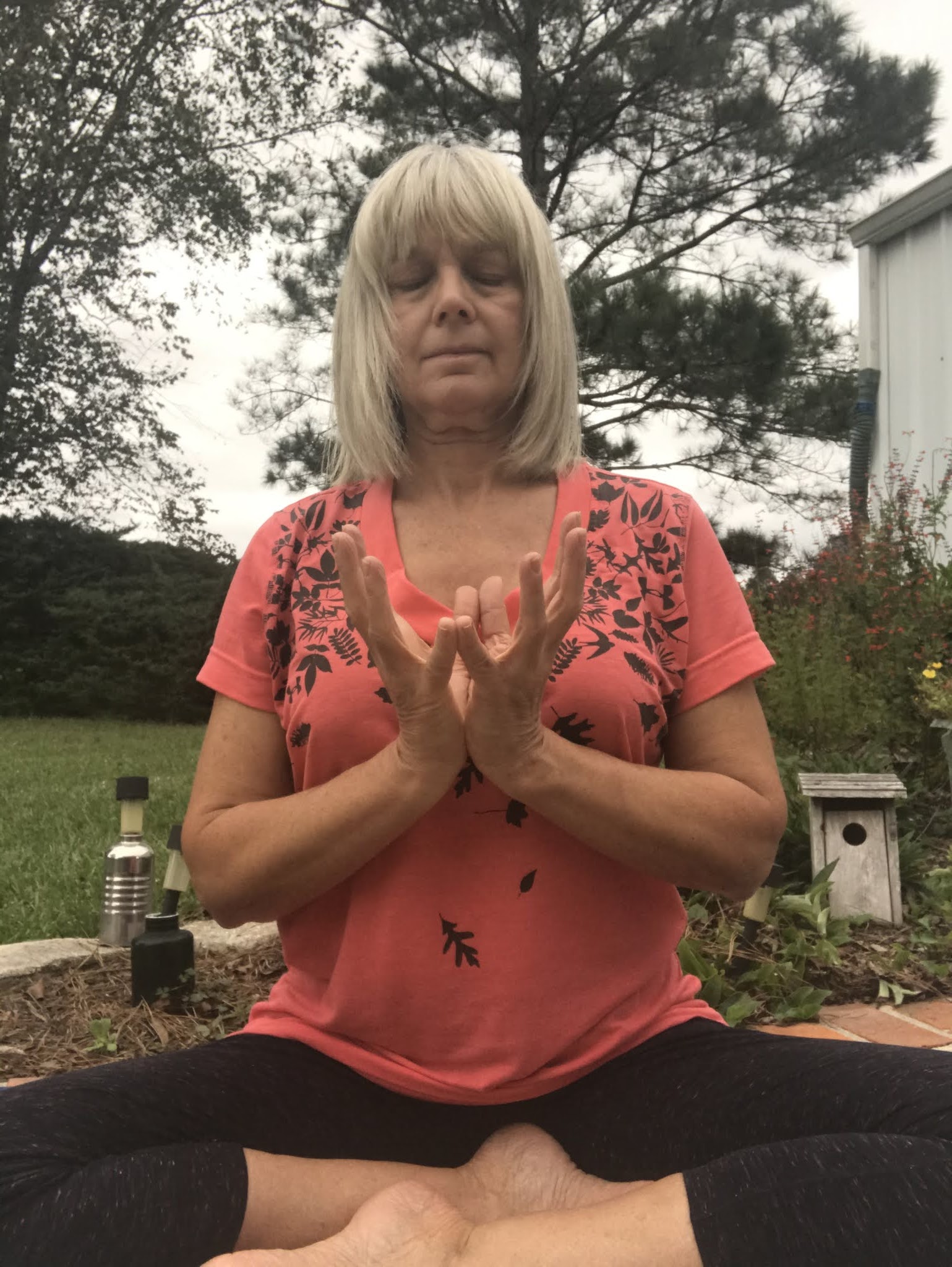
Next, with eyes closed consider the story this month; Praise to the Jewel in the Lotus as you open the hands into Lotus Mudra, fingers spread, thumbs and pinkie fingers stay touching. 


Inhale and reach the arms out to the side and overhead bringing the hands to gently touch as you repeat the mantra; Om mani padme hum. 

Exhale as you stretch over to the right side, right hand touches the earth and left hand reaches over, the left elbow lifts high to the sky, repeat the mantra. 

Inhale and come back to sitting tall as you round the arms overhead bringing the hands to gently touch, repeat the mantra. 

Exhale as you stretch over to the left side, left hand touches the earth and right hand reaches over, the right elbow lifts high to the sky, repeat the mantra. 

Inhale and come back to sitting tall as you round the arms overhead bringing the hands to gently touch, repeat the mantra.

Exhale and fold forward, bring the hands to the earth, walk them out and round the head, neck and upper back down to the ground, repeat the mantra. 


Inhale as you lift the head and neck in line with the spine, walk the hands back towards the body as you lift the shoulders. Exhale and bring the hands down behind the back, lifting the heart and come into a gentle back bend. The chin stays parallel to the earth, repeat the mantra. 

Inhale and come back to sitting tall as you round the arms overhead bringing the hands to gently touch, repeat the mantra.

Exhale and gently twist to the right bringing the right hand back behind the right hip and the left hand to the inside of the left knee, repeat the mantra. 


Inhale and come back to sitting tall as you round the arms overhead bringing the hands to gently touch, repeat the mantra. 

Exhale and gently twist to the left, repeat the mantra. 

Inhale and come back to sitting tall as you round the arms overhead bringing the hands to gently touch, repeat the mantra. 

Exhale and bring the hands down in front of the heart, repeat the mantra.  

Switch out the cross of the legs, and repeat the entire sequence again. Once your hands return to the heart, open them into Lotus Mudra and rest in the Jewel for a few precious moments. Remember you are this precious jewel, you have risen out of the mud and the muck and blossomed into a beautiful, fragrant lotus flower! 

Om mani padme hum

Kathe